Why Mahjong Is Finding New Players
Discover why Mahjong is captivating new fans like Sally, who dives deep into tile sets, strategies, and the joy of weekly game nights!
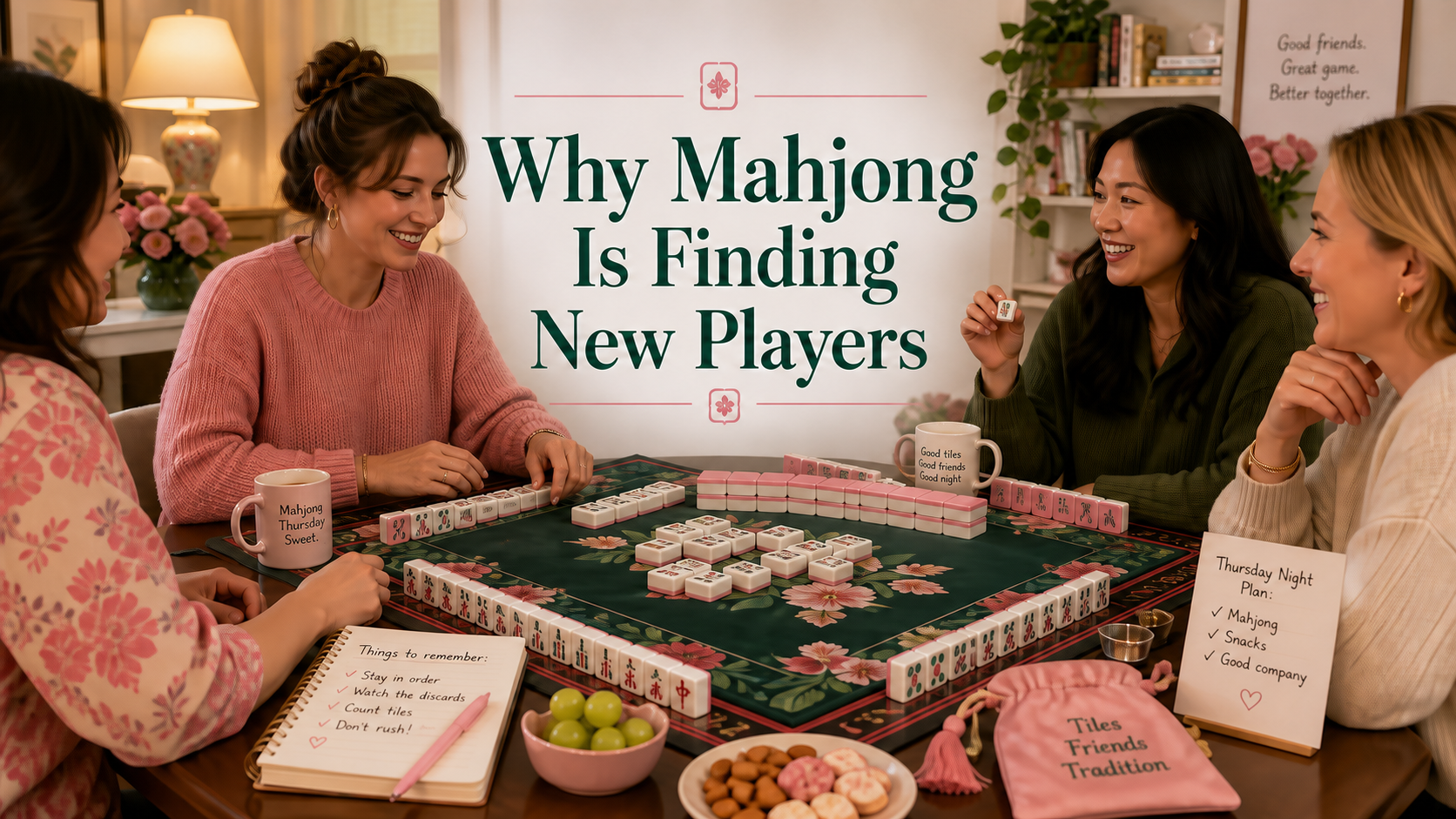
Sally is obsessed with mahjong. Her friend introduced her to the game three months ago.
She has a set of tiles she loves and three friends she's trying to get together Thursday night. She has already sent the group a photo of her new mat. They are discussing snacks.
She took lessons, spent time studying the card, and is beginning to recognize hands she would have missed a few weeks ago. She still needs help. She also wants to play again while what she has learned is fresh, preferably with the friends who learned alongside her.
Thursday is becoming a regular thing. The game is giving them something to plan, something to get better at, and an excuse to spend a few hours together. Sally is already looking forward to it.
You probably know someone with that kind of enthusiasm for a hobby. I think it helps explain why mahjong is finding new players. The beautiful equipment catches their attention, and learning the game gives them a skill they can keep developing with other people. It starts to become part of their lives.
There is evidence of growing interest. ICSC reports that Yelp searches for mahjong clubs increased 4,467%, and searches for lessons increased 819%, comparing September 2024 through August 2025 with the preceding year. Those figures measure searches, rather than the number of people playing, but they show considerable interest in finding somewhere to learn and gather.
Mahjong has a long history behind this current attention. It originated in China and became part of life in Chinese American and Jewish American communities. Historian Annelise Heinz's work examines how the game helped people create friendships, community, and cultural identity. The National Mah Jongg League, founded in 1937, helped establish the American version with its own hands and rules.
I think the game's current appeal comes from several things working together: the people, the challenge, the aesthetics, and the opportunity to create an occasion that feels like your own.
A reason to come back
A game provides a specific answer to “We should get together sometime.”
There is something to arrange: a place, a time, and usually four players. People know what they are coming to do. A newcomer can participate while getting acquainted, and conversation has time to develop alongside the play.
A regular group also gives people a reason to return. Someone remembers to ask how the appointment went. Someone brings a friend who wants to learn. People become familiar enough to notice when another person has been absent.
NPR reported on a gathering at Washington's Capital Jewish Museum where beginners learned alongside experienced players. Some younger participants described looking for inexpensive hobbies that would get them out of the house and off their phones.
That is a practical response to isolation. People have somewhere to go and something to do when they arrive.
The effort gives people something to keep
Your first few games can ask a lot of your attention. There is vocabulary, tile recognition, and the business of understanding what the card is telling you. Then there is somebody who seems to know exactly what you should have done three turns ago.
Learning takes commitment. My sense is that people who make that effort want to get lasting value from it. They want opportunities to use what they have learned, improve, and eventually help someone else.
Research on video games has found that experiences of competence, autonomy, and connection predict enjoyment and continued engagement. I think something similar helps explain mahjong's appeal: becoming capable at something can make people want to keep doing it.
American mahjong provides continuing challenges. The National Mah Jongg League publishes a new hands-and-rules card each year. Experience remains useful while players have fresh combinations to learn.
That combination can give the initial mental effort a long life. There is more to do with the knowledge next month and next year.
Something beautiful to make part of your life
Aesthetic is a large part of this appeal.
The tiles, mats, racks, bags, and table settings give players ways to express their taste. A set can complement a home, become a favorite possession, or make someone look forward to hosting. Choosing it is part of the pleasure.
ICSC's reporting describes the appeal of designed tiles and embroidered mats, alongside classes and gathering spaces attracting new players. The look of the game is helping people discover it.
For many women, mahjong is becoming a “life accessory.” It fits into how they decorate, entertain, spend time with friends, and present themselves. Saying “I play mahjong” suggests a skill and a social activity. The equipment gives that part of their life a visible form.
Beauty can make someone curious before she understands the rules. Learning gives her something to develop. Friends give her a reason to schedule another game. Those attractions can reinforce one another.
I think that matters. People enjoy creating an occasion, choosing things they love, and offering something welcoming to their friends. We should take those pleasures seriously when we consider what makes a good life.
Control over the gathering
Mahjong can also feel less corporate.
There is plenty of business around it. Lessons, memberships, studios, retreats, and equipment are part of the current growth. American mahjong players also buy the annual card. ICSC describes businesses combining retail, instruction, and events around the game.
But a group of friends has considerable control over its own gathering. They can choose where to play, whom to invite, what to serve, and how elaborate the evening becomes. They can use a set for years and keep arranging games themselves.
That control helps explain what “less corporate” might mean. People can buy something that supports an activity they then shape and sustain. The gathering belongs to the people taking part.
Businesses have a useful role when they help someone learn, find other players, or make the experience more enjoyable. That is a good relationship between commerce and ordinary life: a purchase contributes to something people value beyond the transaction.
What ought to grow along with the game
For Between Silicon and Soul, the question is what this growth makes possible for people.
An experienced player has knowledge someone else needs. A beginner has permission to ask questions and improve. People of different ages can meet through a shared interest, with experience determining who teaches whom.
Those are opportunities to treat people with dignity. We make room for their contributions, take their questions seriously, and give them time to become part of the group.
That requires some care from people who already know the game. Explain a rule patiently. Introduce the newcomer. Help someone find a group after the lesson ends. Keep some options affordable and manageable for people whose schedules are difficult.
A beautiful set can attract attention. The experience at the table will help determine whether a new player returns.
I want the current interest to produce more groups people can count on, more friendships, and more opportunities to learn from one another. If someone finishes a beginner lesson with people to play with next week, that is a good outcome worth building on.