Where the Jobs Went
Discover how two neighbors live worlds apart in the same state, as one faces job loss while the other thrives. What's causing this economic divide?
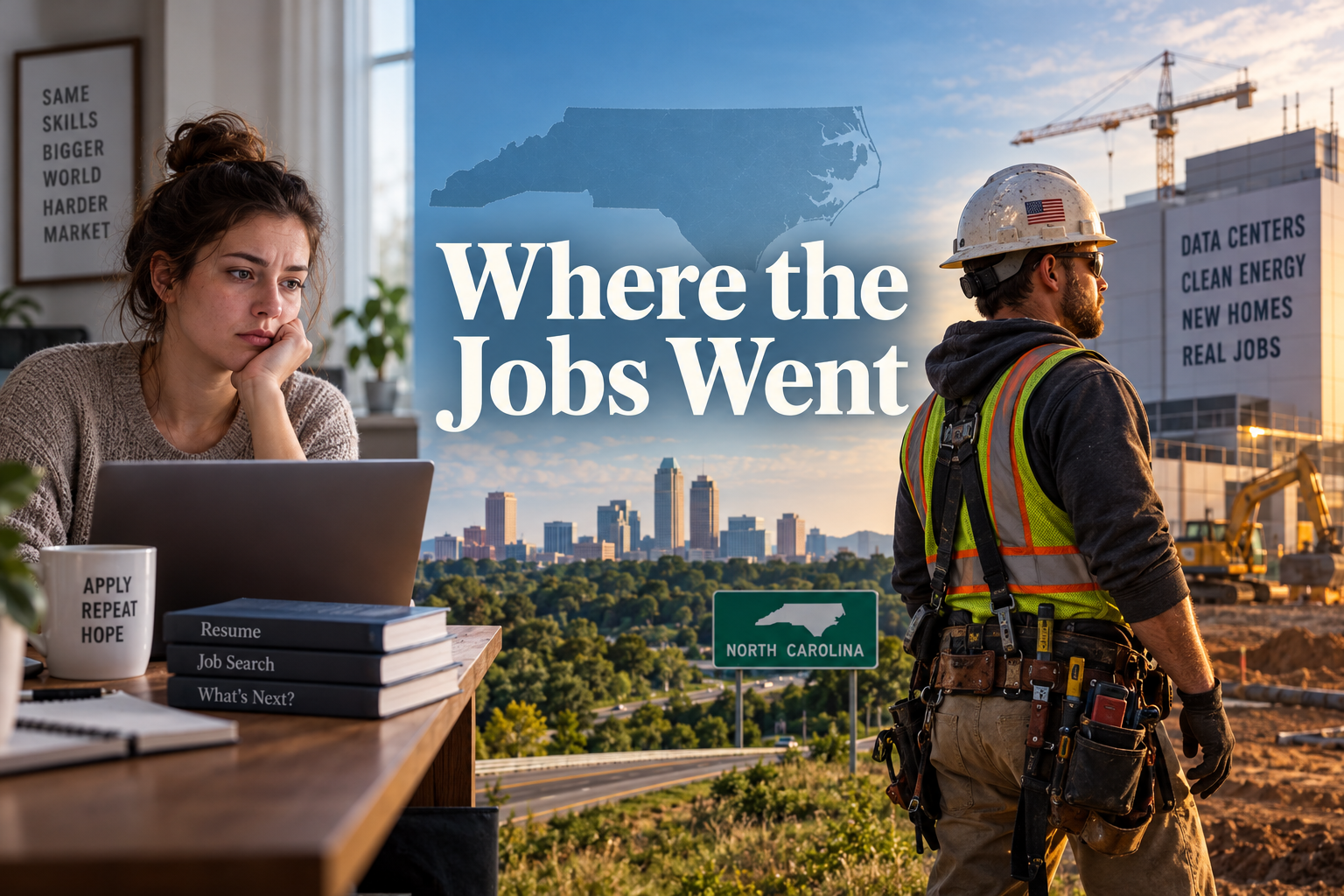
An hour apart
Two people I know live an hour from each other in North Carolina and in two different economies.
One is in her late twenties, a marketing analyst with a good degree, who spent three years working from her apartment for a company in Atlanta she never visited. The role was eliminated in the spring. She has applied several hundred times since. The other is an electrician in his thirties with no degree, booked through next summer by the data center two counties over, the battery plant, and a region that keeps adding houses. He has never had a reason to think about her job. She has started to think about his.
The door that swings both ways
When her job went remote in 2020 it felt like freedom, and it was. She could work for a company anywhere in the world without leaving the town she loved. What took longer to notice was that the door swings both ways. If she could work for anyone anywhere, anyone anywhere could work for her employer. The pool she competed in went from the people within a commute to the people within a time zone, and then to the people within an internet connection, and then to a model.
That is the quiet story of the last five years, and the data has finally caught up to it. The New York Fed's economists estimate that remote work explains about 64% of the rise in unemployment among young college graduates. The jobs that could be done from anywhere were the first to be done by someone cheaper somewhere else, and then by no one at all. A job that does not need a body in a place does not need an American body, or a body.
It did one more thing, which does not show up as a layoff. When the supply of people who can do a job is limited by geography, a company has to raise wages to keep them. When the supply is the planet, it does not. Remote work took the geographic scarcity out of white-collar labor, and with it went the pressure that made wages rise. That is why she can read that wages are keeping up with inflation and know that hers did not. The average is being held up by the electrician.
Where the jobs went, and where they are going
They went to places. The country added 72,000 factory jobs since December and is adding about 33,000 health care jobs a month, in every county, because the population is aging in every county. The building trades have grown all year, because the data centers and plants that the capital is being spent on have to be built by hand, in a county, by someone who lives nearby. These jobs cannot be done from Atlanta. That is their whole protection.
They left the places that were everywhere. Finance and insurance are down 129,000 jobs since May of last year. Tech companies have announced 166,000 cuts this year. The sectors that used to absorb graduates are flat. These were the jobs that could be done from anywhere, which is exactly why they went: anywhere turned out to include a cheaper country and a server.
The Wall Street Journal called the result a split, and it is the sharpest one in the numbers. College-educated workers aged 22 to 34 are in one of their worst stretches in twenty years. Workers without degrees are in one of their best. The degree did not stop mattering. The work moved to where the degree does not help, and the people holding one are standing where it used to be.
Where it keeps going is not hard to guess from inside. The companies I work with are not planning to re-localize the analysis and writing and coordination they moved to anywhere. They are planning to move it further, to the model. Work that needs a body in a place will keep being hired for, and paid well, and the electrician's children will have the choice he did not. Work that needs a mind at a screen will keep being bid down by a planet of minds and then by a machine, until what is left is the part the machine cannot judge, which is the senior work, which you cannot get to without the junior work that is gone.
The building next door
The capital lands somewhere, and where it lands it behaves like the assessor and the underwriter did in October: a body with pricing power over something you cannot do without and no vote you can cast against it. The data center that employs my electrician for two years will employ a few dozen people after, use power like a city, and put the cost of that power into the bill of every household on the utility, most of whom did not know the building was coming until they saw it. The fights over this are now routine in Virginia, Georgia, Arizona and here. The people fighting are not against the tools. They are against a trade in which the value leaves and the bill stays.
What is likely, and what I would prefer
What is likely is that remote work keeps doing what it has done: make the best knowledge workers in the world more valuable and the ordinary ones interchangeable, with wages following. That companies keep building where land is cheap and counties are desperate. And that the advice to the analyst stays what it has been, retrain or move, offered by people who have not priced four years at an apprentice's wage or the cost of leaving a 3% mortgage.
What I would prefer is that companies treat place as something they owe rather than something they shop for: build where the people are, state the permanent jobs rather than the construction ones, and put the cost of the building's power on a line with the company's name on it. And that we stop telling a 28-year-old with a degree that her problem is geography when her problem is that the door she walked through swings both ways and nobody warned her.