We Need to Do Things Together
Discover the power of shared meals and lasting bonds. Sunday dinners weren't just meals—they were the heart of family connection.
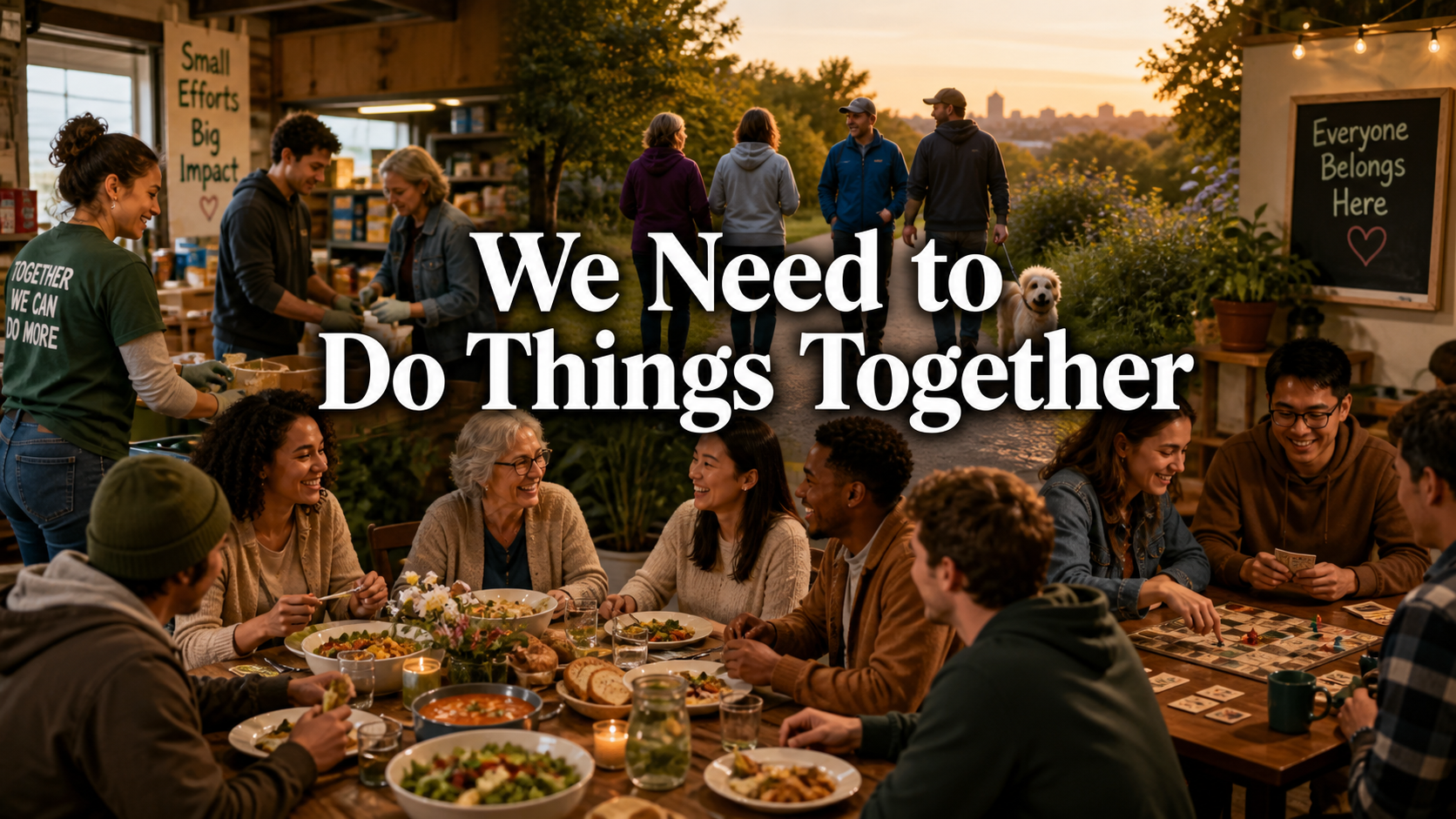
I remember Sunday dinners growing up. I had four sisters, and we ate together several days a week, but Sundays were always special.
My mother's family was large. When we visited, we would often eat with twenty other people, and that was an ordinary visit. A holiday gathering could reach fifty.
I have fond memories of those days. Some of the bonds formed around those meals have lasted through the years, and I expect them to last a lifetime.
I also worked in an office setting for most of my life and made friends and acquaintances that way. Spending time with people throughout the working week gave us opportunities to get to know one another.
Family meals and working alongside people were regular parts of my life. Those occasions gave relationships time to develop, and I have benefited from that in ways I still value.
I think about those experiences when my youngest daughter tells me how hard it is to make time for friends. She works primarily as a pet and house sitter and earns decent money, but the work runs seven days a week.
Dogs still need to eat on Saturday. A booking can cover the days when her friends are free, and the next booking brings another set of responsibilities.
For her, making plans means finding time among those commitments. People with predictable days off have something valuable that does not appear in their paycheck: time they can share with other people.
That matters when we talk about loneliness. We need to do things together, and the way we organize ordinary life can make that surprisingly difficult.
Finding time for people
Side hustles and independent work can provide real income and opportunity. They also leave people responsible for arranging their own time off, covering interruptions, and finding benefits that a traditional employer may provide.
My daughter's work is one example. Other people have rotating shifts, several jobs, young children, or a parent who needs care. By the time they have finished what must be done, another commitment can feel like too much.
In a Pew Research Center survey conducted in 2024, 16% of American adults said they felt lonely or isolated all or most of the time. Men and women reported similar rates. Among adults under 50, the figure was 22%.
Some of those people need an introduction. Some need a ride, an affordable place to go, or an invitation that fits the hours they actually have. Someone can want friendships and still struggle to find the circumstances in which friendships grow.
The strange economy of dating
My daughter also tells me that online dating is a nightmare.
She receives hundreds of requests from men, swipes past most, and encounters messages that are overly direct, to put it lightly. Sorting through that attention can be overwhelming. Deciding whether to meet a stranger also raises questions about safety.
My nephew describes a very different experience. After weeks, he may have received five or ten requests. Several have included direct questions about whether he pays for expensive things.
I understand why both find it discouraging. She has to sort through more attention than she wants, including attention she has good reason to distrust. He receives very little, and some of it appears tied to what he might buy.
Their experiences fit patterns in Pew's 2022 online dating survey. Among people who had used dating platforms in the previous year, 64% of men had felt insecure, at least sometimes, about receiving too few messages. Among women, 54% had felt overwhelmed by the volume of messages. More than half of women under 50 who had ever used these platforms reported receiving unwanted sexually explicit messages or images.
People do form good relationships through dating apps. But I worry about what these experiences teach people to expect from one another. Being repeatedly ignored, approached crudely, or questioned about purchasing power can make the next encounter harder before it begins.
And finding a partner still leaves a person needing friends and a wider community. We ask too much of a relationship when we expect it to supply all the companionship, reassurance, and practical help a life requires.
Having reasons to trust
Deepfakes add another difficulty. In December 2024, the FBI warned about criminals using generative AI to create fictitious identities, clone voices, and fabricate video for fraud, including romance scams.
Working with AI has made me think more about how we establish trust. A convincing image or voice offers less assurance when it can be manufactured. I want people to have opportunities to observe one another's conduct over time.
A shared activity gives us something to go on. We can see who keeps a promise, who explains something patiently, who helps when the work gets difficult, and who respects a boundary.
When my wife and I helped our middle daughter and her husband move, I got to talk with their friends while we worked. Carrying furniture gave us a reason to spend time together. Conversation developed along the way, along with a shared grievance against the people who design couches.
We need more opportunities to get acquainted through that kind of ordinary participation.
Give people something to come back to
Research by Jeffrey Hall, studying recently relocated adults and university students, associated developing friendships with substantial time together. His estimates put casual friendship around 40 to 60 hours and friendship around 80 to 100 hours. Shared leisure and everyday conversation mattered.
Nobody needs a friendship timesheet. We do need to recognize that an introduction is a beginning, and make it possible for people to spend time together again.
There are plenty of ways to do that.
- Share a meal. Soup, sandwiches, or whatever was already going to be dinner. Cook together and share the cleanup. Let an ordinary meal be enough reason to invite someone.
- Play a game. Cards, mahjong, dominoes, chess, board games, tabletop roleplaying, or a cooperative video game. Make room for beginners. Expect to explain the rules again, possibly to the person who eventually beats you.
- Walk or move together. A neighborhood walk, dancing, gardening, or a recreational sport can give people something to do while they talk. Choose an activity and pace the people invited can manage.
- Make, mend, or learn something. Cook, sew, build, photograph, play music, repair a bicycle, or learn to code. Give people real parts in the work, including those who are still learning.
- Help someone. Return to a food pantry shift, a community cleanup, a church project, or another volunteer effort with the same people. There is work to share and a reason to see one another again.
- Use newer tools to keep people involved. A group chat can arrange a neighborhood meal or a tool swap. An online game, shared creative project, or regular video call can keep distant friends participating and include someone who cannot easily leave home.
Even eating together deserves renewed attention. The World Happiness Report 2025 found that 26% of American adults ate all their meals alone on the previous day in 2023, an increase of more than 50% since 2003. Among people living with others, the proportion rose from 12% to 18%.
People sharing meals also reported better wellbeing. The research establishes an association; it does not settle how much eating together causes that improvement. It does give us reason to pay attention to a familiar part of daily life.
Multigenerational living can provide opportunities for shared meals and activities, but sharing an address still requires making time for one another. Let people of different ages teach, learn, contribute, and receive help according to what they can actually do.
Make the invitation workable
For someone with my daughter's schedule, a regular Saturday gathering may be difficult. An occasional weekday meal or a group that welcomes people whenever they can attend may work better.
Say what will happen, what it costs, and when it ends. Offer a ride if you can. Be clear about whether children can come. Choose somewhere accessible. Introduce the newcomer and explain how to participate.
Keep the cost low and the expectations manageable. A person who misses a week should be able to return without having to defend the absence.
Employers have a part here too. Predictable schedules, usable time off, and reasonable boundaries give people a better chance to sustain relationships outside work. Those decisions affect the lives people can build.
People who already have friends can help by making an introduction and extending a specific invitation. “We should get together sometime” leaves the planning unfinished.
What this has to do with dignity
My conviction is that every person has inherent worth. That worth exists before anyone selects their profile, admires their income, or decides they are useful.
We need places where people can become known and where their presence matters.
Shared activities give us a practical way to build those places. A person who has been overlooked gets another opportunity to participate. Someone who doubts what they have to offer can teach a skill or help finish a job. Familiarity gives people things to ask about, reasons to check in, and eventually someone to call.
That is how I think we can begin to repair some of the distrust and isolation people carry. Small experiences of being included, respected, and relied upon give them something better to expect from the next encounter.
There will be awkward evenings and difficult people. Keeping a group welcoming takes patience, clear expectations, and a willingness to address problems. People also need room to learn how to be part of it.
I want my daughter to have time for friendships alongside the work she does. I want my nephew to have opportunities to meet people who can get to know him. I want us to take some responsibility for making those opportunities possible.
We can invite someone to dinner, teach them a game, ask for a hand with a project, and find a time to do it again.