The Snow Shovel
Discover the hidden costs of homeownership through heartfelt family stories. Is owning really freedom, or just another form of rent? Read on.
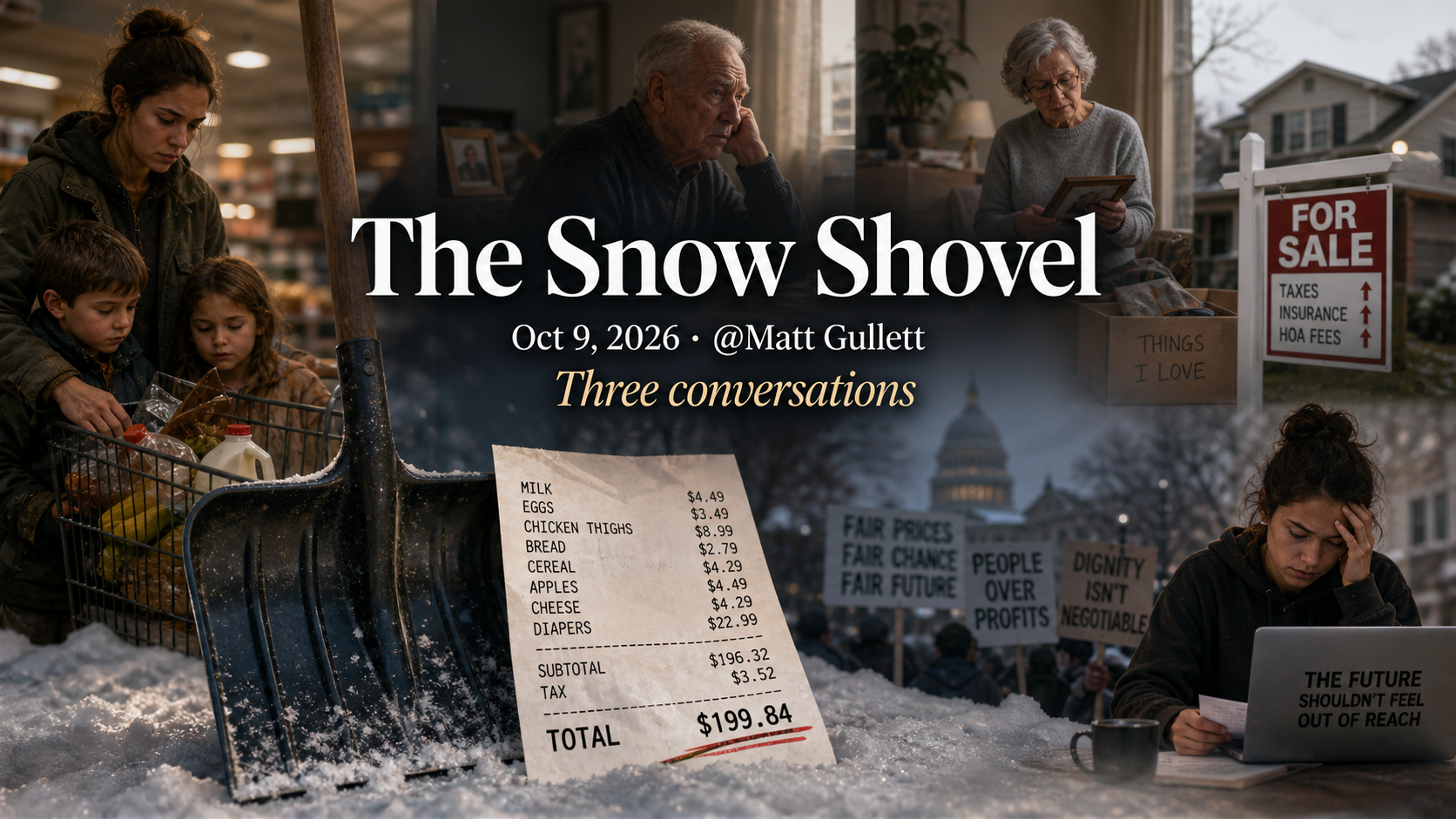
Three conversations
My father lives with us. A few weeks ago he told me about a friend of his, a man in his late sixties, whose house has been paid off for years. The friend said something that has not left me: between the property taxes and the insurance, it feels like rent again. It is not getting easier, and he does not see when it will.
My wife's aunt is 75. Her husband died two years ago. She lives alone in a condo she owns, and we help her where we can. She told us this fall that with taxes, insurance and everything else going up, she may not be able to stay past next year. She has started selling things she loves to cover bills. We have asked her to come live with us. She would rather keep her own door, and I understand that completely. What I cannot make peace with is that nothing around her is built to notice she exists.
My niece had her first baby this summer. The baby is perfect. My niece is in her early twenties, living with her parents, with some growing up still to do. Even if she did all of it by Christmas, the job that would let a young mother raise a child on her own with any dignity is not out there for her to find.
Then my own county raised property taxes. My kids are Gen Z, and I hear what they say at the table. I work in market research, I love numbers, and I notice when the numbers in the reports stop matching the people at my own table. That is what sent me looking. The research follows the trigger. It always has.
The next several posts are about humans making a life in a world that feels increasingly economically hostile and unfair to them. I do not have easy answers though I feel some answers that are likely to come are not what I would prefer. I feel an increasing unease about where we are headed yet hopeful that real solutions will be found.
The receipt
Start with a receipt. A woman in her thirties stands at the end of a grocery checkout on a Thursday evening with two kids, a cart of ordinary things, and a total she has learned to brace for. Milk, eggs, chicken thighs, bread, cereal, apples, the cheese the younger one will eat, diapers. In 2020 that cart came to about $160. This week it is just under $200. Nothing in it has changed except the number at the bottom.
She is not imagining it. Food prices rose 23.6% between 2020 and 2024 (USDA Economic Research Service). Her pay rose too, but not like that, and the gap shows up in the one place she cannot avoid: the store she goes to every week because her family has to eat.
If you asked her who is responsible, she would not hesitate. She would say the grocery chains are greedy. She has heard the earnings reports. Billions in profit. If you then told her that grocers keep about $1.60 of every $100 she spends, she would look at you the way you deserve. She did not ask for a lesson in margins. She asked why the cart costs forty dollars more.
I spend my days reading the numbers she does not read. I have come to believe that she is closer to the truth than the number is.
The snow shovel
In 1986 Daniel Kahneman, Jack Knetsch and Richard Thaler asked people a simple question. A hardware store sells snow shovels for $15. The morning after a big snowstorm, it raises the price to $20. Is that fair? Eighty-two percent said no.
Economists found this puzzling. The store did nothing illegal. Demand went up; price went up. That is how markets are supposed to work. But ordinary people were applying a different rule, and the researchers were able to write it down. They called it dual entitlement. A seller is entitled to a reasonable profit. A buyer is entitled to the price they are used to. When the seller's costs rise, people accept a price increase, because the seller is protecting a profit they already had. When the seller's costs have not risen and the price goes up anyway, people call it what it looks like: taking advantage of need.
The snowstorm is the whole point. Nobody minds a store charging more for a luxury. The anger comes when the thing being repriced is the thing you cannot do without, at the moment you cannot do without it.
That rule has held up for forty years. It has been replicated across countries and across decades. When James Kwak put the same question to a classroom of economics students, the split was close to even. Everywhere else, the 82% holds. The training is the outlier, not the people.
Groceries, insurance and housing are snow shovels. They are the goods people buy because they must, and they are the goods where a price increase without a visible cost behind it reads, every time, as unfair. That is not a failure of understanding. It is a moral judgment, and it is a consistent one.
This is old
The rule is older than the experiment. The historian E.P. Thompson studied English bread riots in the 1700s and found that the crowds were not mobs. They had a theory. Bread was a necessity; there was a just price for it; a miller or a merchant who charged more in a bad harvest had broken a bargain with the community. Thompson called it the moral economy, and it is the same thing Kahneman measured two centuries later with a snow shovel.
America has run this argument more than once, and it has almost always started with food. Upton Sinclair wrote The Jungle in 1906 to expose how meatpackers treated their workers. What moved the country was what they put in the sausage. Within months Congress passed the Pure Food and Drug Act and the Meat Inspection Act. Sinclair said he aimed at the public's heart and hit it in the stomach. The necessity was what people would fight over.
In both world wars the government fixed prices on food and rent, and the word profiteer became one of the worst things you could call a man. In 1973, when beef prices spiked, housewives organized a national meat boycott. In 1978 California homeowners, watching property taxes climb faster than their paychecks, passed Proposition 13 and capped them. A decade later the same voters rolled back auto insurance rates with Proposition 103.
Every one of these was a crowd saying the same thing: this is something we need, the price has become something we cannot control, and someone is gaining from that. Sometimes they were right about who. Sometimes they were not. They were never wrong that the thing being priced was different from everything else.
Honest numbers, chosen rulers
Here is where I part ways with most of what gets written about this. The usual story, the one business people and economists tell, is that consumers are wrong about the facts. Ask Americans what profit the average company makes on a dollar of sales and the typical guess is 36 cents. The real figure for grocery is closer to two. So, the story goes, the anger is a math problem.
I do not think the woman at the checkout is bad at math. I think she is using a different ruler, and I think her ruler is the honest one.
A grocery chain can report a 1.8% margin to the public and $2.7 billion in profit to its shareholders, and both numbers are true. They are the same number. The company simply chooses which one to say to which audience. Margin is a ratio; it goes to the people who need to feel that the business is modest. Dollars are a count; they go to the people who need to feel that the business is winning. Nobody is lying. But the party being judged picked the measuring stick.
The psychologist Gerd Gigerenzer spent a career showing that people, including doctors and judges, reason badly with percentages and well with counts. Tell a patient a treatment cuts risk by 25% and they misunderstand. Tell them it saves one person in a hundred and they get it. The format produces the error, not the person. So when a shopper hears "billions" and shrugs at "1.8%," she is not failing to understand. She is understanding the number that was built to be understood.
And there is a second reason her distrust is reasonable: the facts that are supposed to correct her come from the companies she distrusts. The margin figure is Kroger's own. The loss-ratio figure is the insurer's own. The philosopher Onora O'Neill pointed out twenty years ago that more disclosure from an interested party does not create trust and can destroy it, because the reader can tell it is a performance. Every "here is why your rate went up" letter proves her right.
Not fully rational. Fully human.
Two things this series is not, and one thing it is.
It is not an argument that corporations are evil, or that profit is theft. Grocers do run on thin margins. Insurers did lose money in Florida and Louisiana for years. Property taxes do pay for the fire department. Those facts belong in these posts, right next to the dollar figures, because a reader deserves both rulers.
It is also not an argument that people are wrong to be angry. The feelings in these posts are not always rational in the economist's sense. They are sometimes aimed at the wrong target. But they are completely human, they are consistent across centuries, and they are already shaping how two generations vote, spend, and plan their lives. In January 2024, 59% of American voters said corporate greed was a major cause of inflation, up from 44% two years earlier, and the rise was steepest among Republicans. Only 15% of Americans say they have confidence in big business. Among adults under 35, more now say they view socialism favorably than capitalism. You do not have to agree with any of that to see that it is real, and that it is not going away.
The center of my work is a simple claim: people have dignity, and the forces acting on them either honor it or do not. The woman at the checkout has dignity. So does a 75-year-old widow deciding whether she can keep her condo. So does a 24-year-old who cannot find work that would let her raise her child alone. None of them need to be right about margins for their situation to matter. What they need is for someone to tell the truth about what is happening to them, who it serves, and what it will cost.
People are already moving
What it is: a series about what people are doing with that anger, because they are not waiting for anyone to validate it.
They are moving their money. Thirty-eight percent of Americans say they boycotted a brand in the past year. Target's foot traffic fell for 25 of 27 weeks after it walked back its diversity commitments. Drivers are shopping their car insurance at the highest rate ever recorded. Store brands keep taking share from the names on the shelf.
They are moving their votes, and in both directions at once. In 2026 Congress banned large investors from buying single-family homes; the idea came from a Republican president and a Democratic congressman at the same time. New York outlawed algorithmic rent-setting. New York City elected a mayor who campaigned on city-run grocery stores. California's insurance commissioner now holds public hearings on rate increases that used to be filed and forgotten.
They are moving the conversation. The receipt gets posted. The shrunken package gets photographed. The denial letter gets read aloud. Companies spent a century speaking to customers; the customers now speak back, to each other, at scale, and the companies are not in the room.
So the question this series builds toward is not whether people are right. It is what organizations will do now that people are acting. A grocer, an insurer, a landlord, a county: each one is going to have to decide where it stands on the dignity of the people it serves, and say so in a language those people can check. The ones that keep answering dollars with margins will not be believed. The ones that answer the actual question may be.
What's coming
Over the next two weeks I will write four more posts. Each one is about people I know or people whose situations I have studied closely, backed by the best data and the best psychology I can find.
- Entry denied. The young people in my own family and what it is like to be 24 and watch the gate close on a house, a stable job, and a family of your own. Why the frustration is getting stronger with age, not weaker.
- Holding on. A paid-off house that feels like rent. Older homeowners, property taxes, home insurance, and HOA boards, and why losing what you already earned hurts more than never getting it.
- What happened to the good years? Insurance as the sharpest case of a company and its customers believing two different things about the same contract.
- Two vocabularies, one demand. Why a 24-year-old who says "socialism" and a 68-year-old who says "cap my taxes" are asking for the same thing.
Every post puts the dollars next to the margins, says when the company is right and when the customer is, and ends with the same question: what does this organization owe the person at the center, and what happens when it does not pay? The number at the bottom of the receipt was never the point. The person holding it is.