Quiet Moments of Reflection
"Reflecting on loved ones aging is a journey of bittersweet moments. Discover how quiet strength and resilience shine in life's tender transitions."
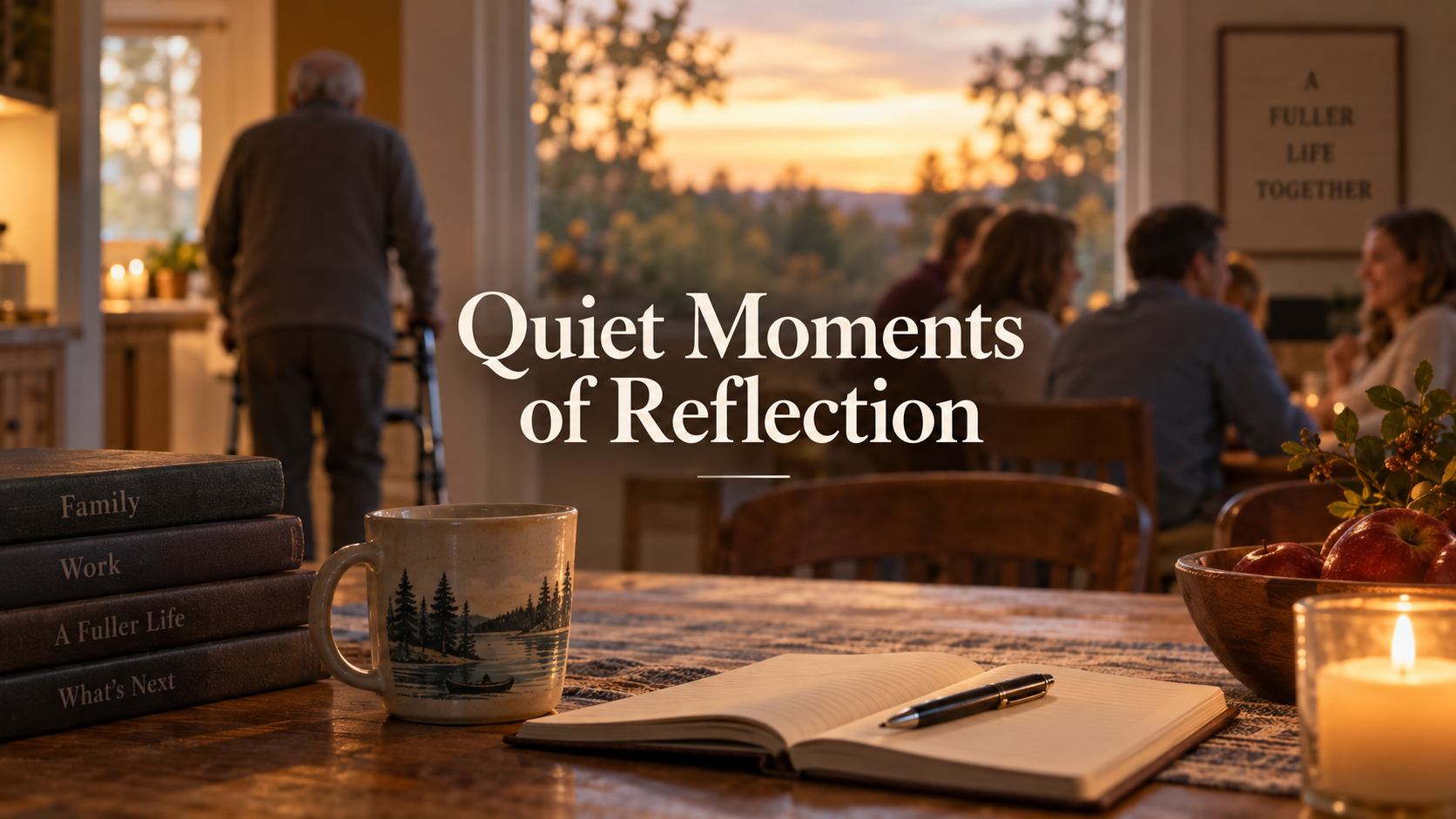
The house is filling
My father lives with us, and his steps are getting shorter. He stumbles more than he did in the spring. He needs his walker all the time now and resists it most of the time. The line of where this goes is clear enough. It is just sad to watch a man who taught me to fish, to use a chisel, to run a power tool reaching for the wall on the way to the kitchen so he doesn't fall.
My wife's aunt fell a couple of months ago and fractured several vertebrae. She is a small woman and she is 75, and in November she will have surgery on her back. She will need more help afterward than she can get alone in her condo. The offer we made her this spring, to come and live with us, the one she thanked us for and did not take, is going to come up again, and I think this time the answer will be different.
So the house is filling and that is uniquely personal and simultaneously not that uncommon. I wrote in October that the family has become the shock absorber for what the institutions fail to do. I did not expect to be writing about my own family this quickly. It is not a burden, it is an honor, and yet it can be a burden too. Life is like that. It is the thing the old books say a household is for.
The last stretch
I have been with the same company for most of my working life, and at some point, not soon and not never, that will end. I used to picture what came after the way my father's generation did: a date, a party, a long exhale, lots of fishing. I do not picture it that way anymore, and I am not sure the picture was ever available to me, and more than that, I am not sure I want it.
What I picture now is closer to a change of pace than a stop. Less of the work that a large organization needs from me and more of the work I would do if nobody paid me, which, it turns out, I already do: write books, make things in the workshop, the small businesses that have started to need more than evenings, and family - lots of that. If the ventures my family is building this year hold, the last stretch may involve hiring people and helping others build their work lives. If that happens, I plan to apply what I have learned to that and try and deliver work that is fulfilling and dignified.
Life has had many twists and turns and I am sure those will continue as time goes by. I very much doubt that a straight-line prediction of how the future will look for me would yield an accurate view. And I also realize that my current situation sits apart from many who are struggling with the job search, who are trying to decide if now is the time to start a family, and from those anxious about increases in the cost of living.
What the young mean by retirement
My kids do not use the word retirement the way I do, when they use it at all.
For my parents it was an age. Sixty-five, a check from the government and one from the company. For me it became a number: the amount in the account that lets you stop. For the people in their twenties at my table it is neither. While young people rarely have a good grasp of 30- or 40-year time frames, this generation does not view retirement as a singular event. It is a series of exits. Leave a job that is grinding you down, take six months, come back to something else. Work for yourself for a while. Take care of a parent. Have a child without waiting for the perfect year. The phrase I have heard is micro-retirement, which sounds like something a consultant invented and is actually something a person does when she has decided that the long deferral her parents accepted is not on offer.
They are not wrong to decide that. They watched the deferral fail. They watched a generation work forty years for a pension that became a 401(k), a house that became a liability, and a Social Security check that, they are told from every direction, will not be there in full for them. So they have stopped saving the good years for the end. They take them as they go. The data says Gen Z started saving for retirement earlier than any generation before them, because the plans enroll them automatically, and at the same time they say in every survey that they do not expect the system to hold. They are putting money away for a future they do not believe in, and spending the present as if it is the only thing they are sure of.
From my side of the table that looked, for a while, like carelessness. I think now it is closer to Ecclesiastes than anything my generation did. Eat your bread with gladness. There is nothing better for a person under the sun than to enjoy the work of his hands, because the rest is not promised. They did not learn that from a religious text. They learned it from the economy and from observing their world.
The cliff
They are right about the system, by the way. It is not a rumor.
The trustees of Social Security publish a report every year, and this June's said what the last several have said with the date moved up a quarter: the retirement trust fund runs out of reserves in late 2032. When it does, under current law, the program pays what comes in and no more, which is about 78 cents on the dollar for the more than sixty million people collecting retirement benefits at that moment. If Congress lets the retirement fund borrow from the disability fund, the date moves to 2034 and the number to 83 cents. Either way, it is inside the term of the senators being elected this fall. The trustees say this every year, in a sentence recommending that lawmakers act in a timely way so that changes can be phased in gradually. They have been writing that sentence since before my daughters were born.
So the young person who says she does not expect Social Security is not cynical. She has read the report, or someone has read it to her. What she expects is a cut, or a tax, or a later age, or all three, decided late and badly by people who were told. She is planning around it. The surveys that say Gen Z distrusts institutions are measuring, in part, a generation that has done the arithmetic the institutions keep declining to do.
And here is the part I turn over. The people who will be collecting in 2032 are my father's friends and my wife's aunt and, not long after, me. The people paying in are my daughters. The cliff is a transfer, and the transfer runs from the generation that cannot get in to the generation that is trying to hold on. That is the same two groups from every post this fall, in one more place, on one more ledger that nobody in Washington has balanced.
Another shoe
Getty Images filed for bankruptcy this week.
If you have ever licensed a photograph for anything, you know the name. For thirty years it was the place the world's pictures lived: the wire photo of the game, the stock image of the handshake, the archive nobody else had. It went public again in 2022 at nearly five billion dollars. By last Friday its shares were worth about twenty million, a loss of ninety-nine percent, and the exchange had begun delisting them. It carried two billion dollars of debt against fifty million in cash. Its paying subscribers fell from 321,000 to 241,000 in a year. The founding family and a private investor are putting in half a billion to buy it back and take it private, and the company says it will survive by focusing on the one thing a model cannot make: the photograph of the thing that actually happened.
The stated causes are a failed merger and too much debt. The cause underneath them is that eighty thousand customers stopped paying for a picture of a handshake because a model will make one for free. Getty's house of cards has been shaken, and it won't be the last.
That is not a story about Getty. It is a story about every marketplace where people were paid for the ordinary, competent, interchangeable work, the stock photo, the first draft, the product description, the background music, and about what happens to the people who made it. The photographers who supplied that archive were the first rung of a creative career. The archive is not going anywhere, the company says. The rung is.
The work I do
I cannot write about Getty without writing about my own work, because the line between them is shorter than I would like.
Market research is still, mostly, what it has always been: asking people what they think and trying to hear the answer. But AI is pushing on it hard, and on the company I have spent most of my career with. Part of my own focus is synthetic respondents, systems built to answer a survey the way a particular kind of person would, so a client can test an idea against a simulated audience before, or instead of, asking a real one. It is good work. It is careful work. It can make research faster and cheaper and, in some cases, reach people a panel would never reach. I also believe it can make market research better.
And I lie awake some nights with the question every post this fall has been asking, turned on myself. What does it do to a person's dignity if a machine can articulate their feelings or ideas without their involvement? If the whole argument of these two series is that the institutions stopped listening to the people they make money from, what am I building when I build a way to hear from people without asking them? I do not think the answer is that I should stop. I think the answer is that a synthetic voice must never be allowed to replace the right of a real one to be heard, that it has to be checked against real people constantly, and that the people it stands in for should be better off for its existence, not quieter.
The feed this week
The feed did not pause for my reflection. More day-ones this week, more rounds of layoffs announced in the language of efficiency, more people in my network writing the post that starts with the date they found out, and one from someone at the end of their mortgage forbearance who doesn't know what to do.
The official count came out last week: 29,000 jobs added in September, against a workforce of 160 million. Layoffs low. Hiring frozen. Nearly two million people out of work more than six months. The same shape as every month this year. The companies reporting this quarter are, so far, reporting records.
I am no longer surprised by any of it, which I think is the thing to notice. Two months ago the gap between the number and the person was the subject. Now it is the weather. I check it the way I check the forecast, and I have to remind myself that behind every one of those posts is a kitchen table where the arithmetic is being done tonight.
Life continues
And yet.
This week the mahjong brand my family has been building for a year launched its first line, and the other shops are heating up for the fourth quarter the way they do. My father and I talked about his friend's house again. There have been many calls with the surgeons about November. My daughter and I chatted about the live tree she wants this year. In our house Christmas starts early, and every year is different. There will be one more chair at the table this year, maybe two.
My wife and I have started talking, more openly than we used to, about hoping for grandchildren. Our children are talking about the future too, in the other direction: about whether they can afford it, whether the work will be there, whether it is fair to bring a child into the world they see. Both conversations happen in the same house, sometimes in the same room. Neither of us is wrong.
Ecclesiastes says there is a time to weep and a time to laugh, a time to mourn and a time to dance, and it does not say they come in separate seasons. This fall they came together. A father reaching for a wall and a daughter laughing at the table. An aunt's surgery on the calendar next to a launch date. Work I believe in that I am not certain is right. Tears and joy, in no particular order, on the same Thursday. I used to read Ecclesiastes as resignation. I read it now as the most honest description of a life I know: jagged, unfinished, unfair in places, and full of things worth doing.
The family, the work of your hands, the table, the Sabbath, the feast. Those are not what we are fighting for. They are what we are fighting with. The companies and the counties and the Congress will do what they do, late and imperfectly, and it will still be progress, jagged and real. I will go back to arguing in a week or two. There is a future worth working toward and I intend to write about it. But not tonight. Tonight there is a table, and more people coming to it than last year, and I have been told by someone wiser than me that there is nothing better under the sun.