Not Hired
Discover the unexpected journey of my daughter's pet-sitting success and the life lessons it teaches us all. Dive into her five-star story!
The other side of the equation
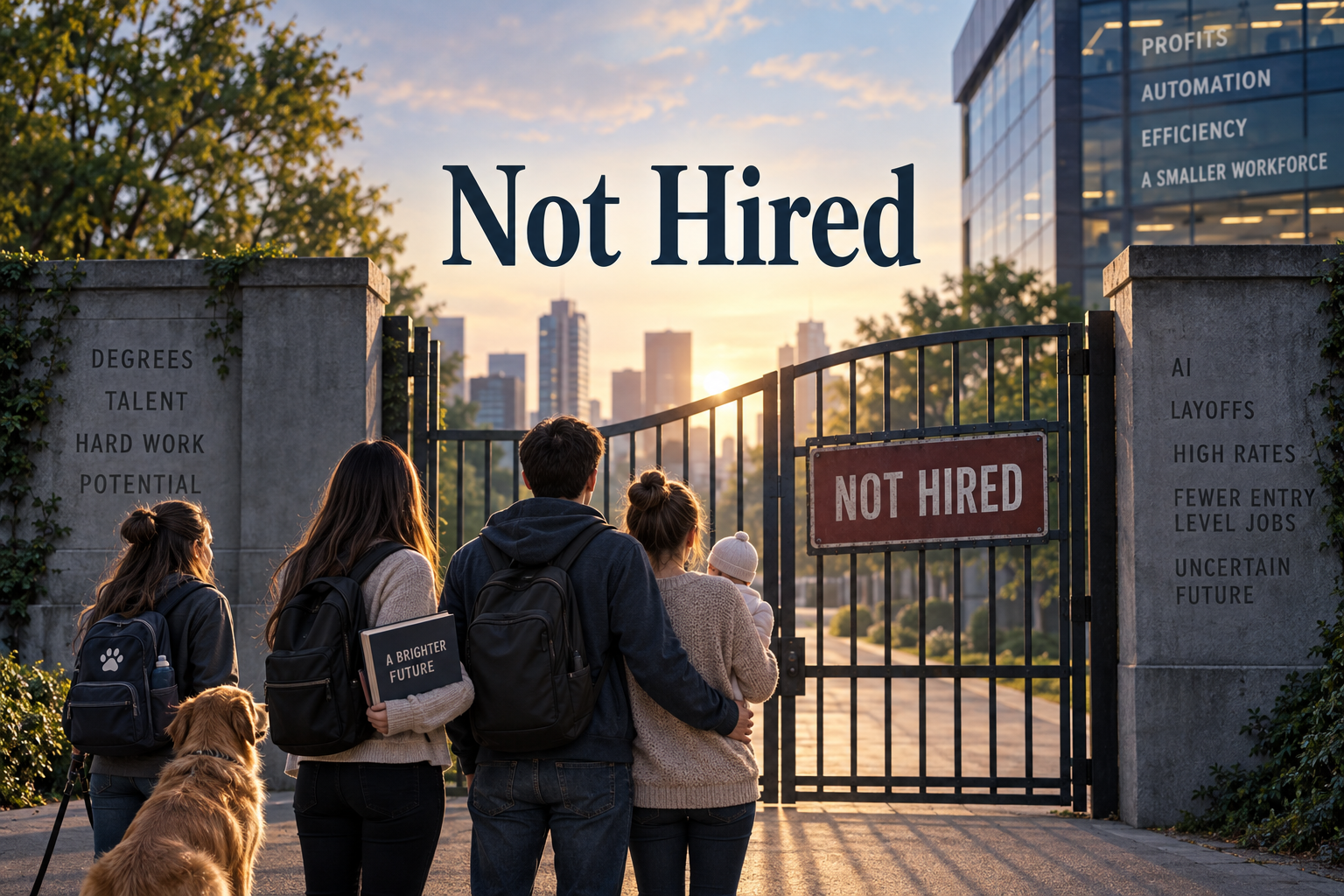
If you have followed me, you know my kids and extended family drive much of my world view, though I also do research to extend my understanding. You have also likely read me writing about my youngest daughter whom I am very proud of. She pet-sits and house-sits, and she is good at it in the way that matters: people hand her their keys and their animals and they come back. She has the most 5 star ratings (and only 5 star ratings) on Rover anywhere near where we live. I am proud of that too. She built that because the jobs she was looking for were not there to be found.
My middle daughter and her husband are waiting on 2027. Raises, they hope, that will change the math enough to start the family they want. They are doing everything the old advice said to do, in a market where the old advice assumed someone would hire them, pay them a fair wage that was livable.
My niece had a baby this summer. She is in her early twenties and has some growing up to do, as all of us did. The thing I can say is that even if she finished all of it tomorrow, the entry-level job that would let a young mother support a child on her own is mostly not out there anymore without specialized . The requisition that would have been her first step closed in a room like the one I described, for reasons that were sound.
These are the people on the other end of the call.
The gate, in numbers
The Federal Reserve Bank of New York keeps a series on recent college graduates, ages 22 to 27. In the middle of 2026 their unemployment rate was about 5.6%, against 2.9% for college graduates as a whole. Their underemployment rate, the share working jobs that do not require the degree, was 42%, the highest since 2020. A recent graduate is now about twice as likely to be out of work as the average graduate, and more than four in ten who are working are doing something the degree was not for.
The Wall Street Journal, using Burning Glass data, put it more bluntly in September: college-educated workers aged 22 to 34 are in one of their worst stretches in twenty years, matched only by the pandemic and the long recovery after 2008. In the same month the Journal reported that workers without degrees are having one of their best job markets in years. The degree premium for the young has nearly closed. In 2010 a recent graduate's unemployment rate was nine points lower than that of a young person without a degree. In 2026 the gap is about a point and a half.
And they stopped being created inside a market that looks fine from a distance. Unemployment is 4.2%, which an economist reads as healthy and which is also seven million people. Nearly two million of them have been looking for more than six months. Every one of them is looking in the year that rent, a family health plan, car insurance and groceries cost more than they ever have, and in the year that corporate profits reached the highest level ever recorded. The 4.2% does not know any of that. It counts who lost a job, not what losing one costs now, or who is doing well while they look. The hiring rate, the number that measures whether anyone is adding people, is at its lowest in more than a decade outside the pandemic. The young feel that first, because they are the ones who need to be hired. Everyone else just needs not to be fired.
Is college still worth it?
Is college still worth it? For the people who finished twenty years ago, the answer is yes; the lifetime data says that in most fields, a degree paid. That data has been stable for a long time. But that is a backward-looking number, built from careers that began when the first rung existed. The question a 19-year-old is asking is forward-looking: will this debt pay off for me, starting now, in this market and the market that is likely to exist as my life progresses? Nobody has that number and nobody can offer any real proof that it will continue except past performance which is exactly what stock advice tells everyone to be leery of. What the data can say is that the first rung, the jobs that used to turn a degree into a career, is the thing that stopped being created, and whether a degree is worth it depends on whether that rung comes back.
My two oldest are living that question from opposite ends. Both have degrees. The oldest also has a master's. One studied the humanities and one studied physics, which is about as far apart as two educations get, and they have arrived at the same place: each of them asks, out loud, whether it was worth it, and whether it will ever really pay off. Both carry debt they will be working to clear for the better part of ten years. The humanities degree was supposed to be the risky one and the physics degree the safe one. In this market neither of them can tell the difference, and that is the part the lifetime-premium chart cannot see. It averages across fields and across decades. My daughters are not an average. They are two people with two different degrees, one set of loans each, and a first rung that was not there when they reached for it.
Did AI do it?
The people at my table are sure it did. The economists are not, and their reasons, both sides, are good ones. Both cases are below.
The case that AI did it. Erik Brynjolfsson's team at Stanford, using payroll records for millions of workers, found that employment of 22-to-25-year-olds in the occupations most exposed to AI, software development and customer service above all, fell sharply after late 2022 while older workers in those same jobs held steady or grew. By their latest update the gap had widened to 19%. A Census Bureau working paper found hiring of 22-to-24-year-olds in the most exposed industries dropped about 9% right after ChatGPT appeared. The pattern is exactly what you would expect if companies kept their experienced people and stopped buying the rowing.
Then there is the case that it did not. The Federal Reserve raised rates aggressively starting in March 2022, eight months before ChatGPT, and hiring in those same occupations began falling then, not later. A paper from the London School of Economics and Warwick, using hundreds of millions of hires and postings across four countries, found that once you account for how remote-friendly a job is, the AI effect on junior hiring mostly disappears; the collapse of junior roles tracks work-from-home, not the model. A New York Fed study puts a number on it: remote work explains about 64% of the rise in young-graduate unemployment. Ramp's economists found that companies spending the most on AI grew their entry-level headcount 12% over two years. Stanford's own policy brief, co-written by the former commissioner of the Bureau of Labor Statistics, concluded that AI's effect on overall employment is likely small for now, though a tough market for new graduates may be partly due to it.
Here is what I can add from inside. Start with the question the economists' measures skip. If corporate profits are rising, and they are at a record, why are more jobs not being created? Not fewer layoffs. New jobs. A company earning more than it ever has, with cheaper money than it had in 2023, would ordinarily hire. It is not hiring. That is where AI has its bite, at first: not in the layoff it causes but in the hire it makes unnecessary. The economists are measuring layoffs and employment, and AI is not showing up much there. It is showing up in the room I described, as a potential hire that never materializes. Hiring avoidance does not appear in a layoff statistic. It appears in a hiring rate at a decade low, and in a 24-year-old's inbox.
What comes next I can say with more confidence than most of the people arguing about it. Organizations will get more comfortable with AI. They will learn where it fails and what it costs and what it implies, and they will adapt. Whole industries will. That part is guaranteed, because that is what markets do with a cheaper way to produce. How it ends is not guaranteed at all. But jobs will be displaced along the way, in numbers, and everyone can count on that whatever the current statistics say. The early sign is already visible: the trades are hiring, and knowledge work is not. If that is the shape of what is coming, then the traditional path, a degree into an office, is a less certain road than it was, and the young people asking whether the debt will pay off are asking the right question. Interest rates and remote work opened the gap. AI is now the reason it does not close. The first two were weather. The third is a choice, and the choice is being made by people like me.
The water's fine, don't come in
This summer a newsletter widely read in my industry surveyed several thousand tech workers about how they feel. The headline was that the workforce is splitting in two: about half feel amplified by AI, more capable than they have ever been, and the rest feel shaken, less sure of their value. But the finding I keep returning to was this: asked whether they would recommend a career in their own role to a friend starting out today, more than half said no. A third of the people who called themselves optimistic about their own future still would not recommend their field to a newcomer.
The survey's authors summarized it in five words: the water's fine, don't come in.
One respondent said, roughly, that she was lucky to be late in her career, that AI could amplify what she had already built, that she would probably never be in a position to hire and mentor new people again, and that this felt crappy to say. Another said he could retire whenever he wanted and was not worried about himself, only about the younger generations.
I recognize both of them. They are inside the bubble with me, and they have noticed what I noticed at dinner: that the deal works for the people who are already in, and that the on-ramp they used is gone. The difference between them and the companies they work for is that they are willing to say so. The company reports the record quarter. The employee, anonymously, admits she would not let her own kid follow her.
The tool arrived and the apprenticeship left
In the first post I celebrated the gate opening. A teenager can make a film alone now. Someone who cannot draw can make a picture that lived only in her head. I meant every word, and I still do.
Here is the other half. The same tool that lets a 24-year-old make a film alone is the reason nobody will hire her as the assistant who learns how films get made. The rowing was never only cheap labor. It was how a person became someone who could steer. You coded the open-ends for two years and one day you noticed the pattern the senior missed. You formatted the slides for a year and one day you understood why that chart was wrong. Every craft I know, woodworking included, is learned by doing the dull parts under someone who has done them longer. The dull parts are what we automated first.
So we have arrived somewhere strange. The tool makes a beginner more capable than a beginner has ever been, and at the same time removes the path by which a beginner became an expert. The beginner can produce. She cannot, as easily, learn to judge what she produced, because judgment came from the rowing. And judgment, as I said at the top, is the one job the machine hands back to you.
I do not think this is permanent. I think it is unsolved, and I think it is unsolved because the people who could solve it, the companies that benefit from the tool, have no quarterly reason to. An apprenticeship costs money in year one and pays off in year four, which is three quarters past anyone's bonus horizon.
What is likely, and what I would prefer
What is likely is a decade of entry-level postings that require three years of experience. Credential inflation, as the master's degree becomes the new bachelor's and buys the same nothing. A generation that enters the workforce at 27 through the side door, after years of gig work and living at home, with the apprenticeship years simply missing from their lives. And then, when the people who could have hired them discover they have no senior staff in 2035 because they trained none in 2026, a sudden panic about the talent pipeline, and a consultant's report about it.
What I would prefer is that companies bring the apprenticeship back on purpose and say so. Not an internship program as a recruiting brochure. A stated commitment, published next to the earnings, that a certain share of hires each year will be people with no experience, paired with someone who has it, doing the real work with the tool and learning to judge what the tool produces. The rowing can be done by a machine. The learning to steer cannot be, and it has to be paid for by someone, and the someone who benefits from a trained senior in 2032 is the company that hires her junior now.
I wrote last month about a kind of corporate austerity, and I meant it to carry over here. Not layoffs, which the customer never reads as restraint. The other kind: fewer stadiums and halftime ads, and a longer horizon than the next quarter's profit target. A company that measures itself over five years hires the junior in year one because it needs the senior in year four. A company that measures itself over ninety days never does, because the junior is a cost this quarter and the senior is somebody else's problem. Human capital is the one asset on the books that gets more valuable the longer you hold it, and we have built a reporting cycle that treats it as the first thing to throw out.
The temperature of how people feel about corporate profit is changing, and I can measure that for a living. It is not enough anymore for a firm to be aware of it. The firm has to act in a way that shows the exchange is still worth it to the person on the other end. Not only at the register, where the product has to be worth the price. Not only in the quarterly report, where the return has to be worth the risk. At the human level, where the years someone gives a company have to be worth more than the years the company was willing to give back. That exchange is what people are judging now, on the feed, every day, and the verdict is in before the earnings call starts.
Here is what my own industry did, because that was the rule I set. Market research used to hire a lot of young people to do exactly the work I now automate. Coding responses, cleaning data, building the first draft of the deck. Those were the jobs that made analysts. My team built systems that do them in minutes, and I am proud of the engineering, and real people are employed operating and improving those systems. But fewer of them are 23. The company I work for still hires young people, and I am glad that we do.
My daughters and my niece do not need me to settle whether AI did this. They need someone to open the door. The tools will keep getting better. That part is coming whether anyone likes it or not. Whether there is a first rung for the people who will have to judge those tools is a decision, and it is on my side of the table, and I am going to try to make it out loud.