Human Dignity and the Cost of Ordinary Life
Moving woes and feline antics: our ordinary day unveils the hidden costs of life and human dignity. Dive into a tale of humor and heart.
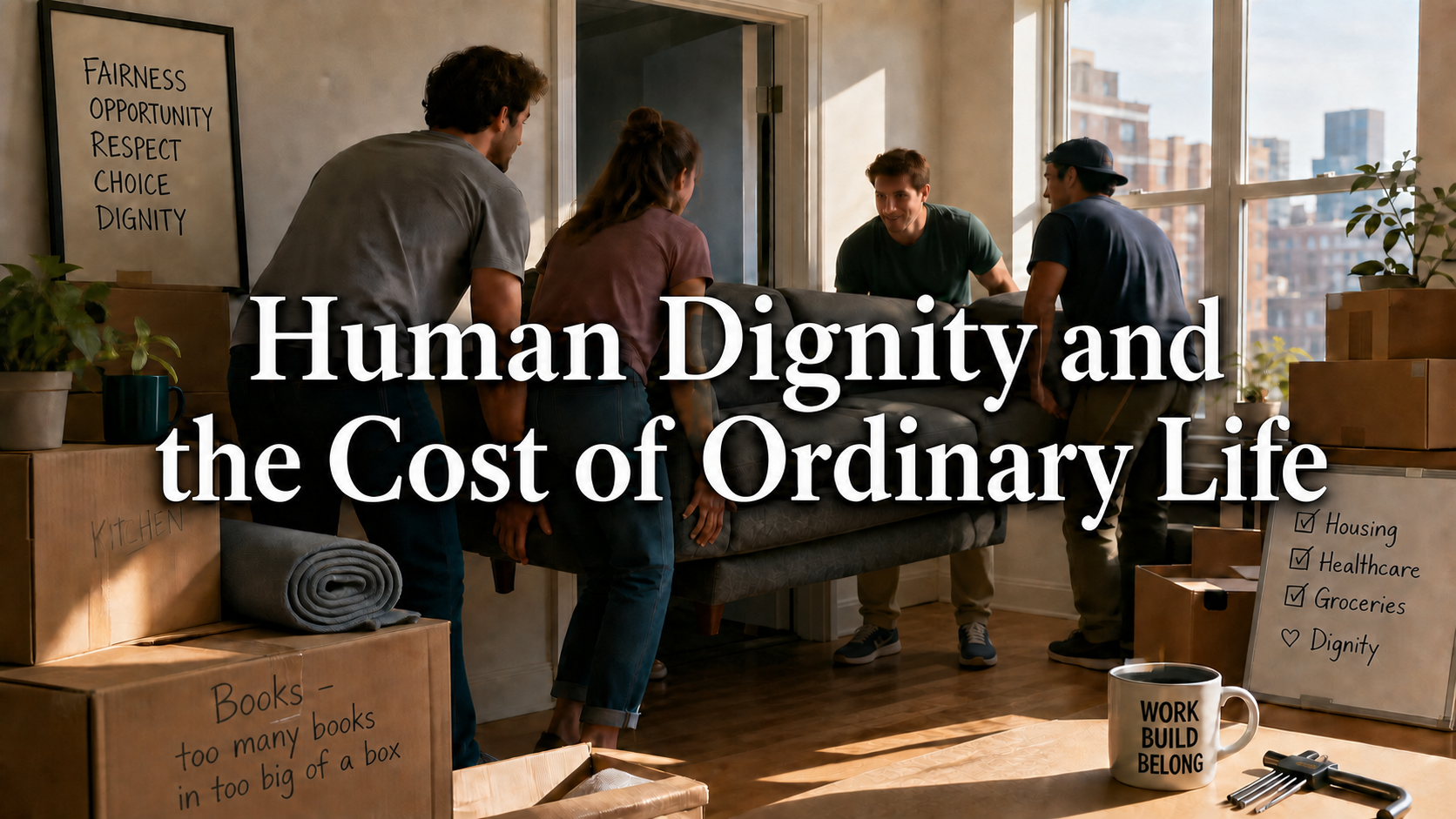
Last month, my wife and I helped our middle daughter and her husband move into their second apartment. Two bedrooms, two friends who showed up to help, one couch engineered by people who hate people, and a cat determined to start a new life on the outside.
The couch got stuck, twice, of-course. The cat, thankfully, never escaped but I have scratches to prove that he put in the effort. And don’t get me started on Allen wrenches – like – how many different sizes are there exactly and who owns one? (Nobody at the apartment is the answer to the second question. Nobody knows the answer to the first.)
There was banter, real work, and time to listen. The two friends approached their futures differently. One had been through considerable difficulty and was hardworking, hopeful, and proactive. The other was more disillusioned. Both leaned toward socialism in ways that I have seen repeated in many encounters with this younger generation.
That concerns me. It also interests me that the hopeful one holds those views as firmly as the discouraged one. Whatever draws them, it isn't simply bitterness.
Paying for the ground floor
Housing, groceries, and healthcare keep coming up when I talk with young adults. Yet they carry phones and drive cars made by profitable companies, and I hear far fewer complaints about those.
A phone is something a person chose. If they don't like the price, they can buy a different one or keep the old one longer. The exchange feels fair.
Rent is different. It shapes how much someone can save, whether they can leave their parents' home, which jobs they can take, and what commitments they can afford. Healthcare's price arrives when you're already sick. Groceries come back every week because the need does.
Buying something you want can feel satisfying. Paying for a necessity can feel like it takes away from opportunity for growth where you want it.
Dignity in the transaction
My conviction is that every person has inherent worth, apart from income, usefulness, or purchasing power. A price increase, a claim denial, or a surprise fee has a financial cost. It also tells a person how they are regarded. Advertising also can subtly speak to people in surprising ways, with one of these friends commenting that “you have to be rich to afford good quality food.”
People lose trust in business when they believe their dependence is more valuable to a company than their wellbeing.
That helps explain how someone can enjoy what private enterprise makes and still want socialist answers to essential needs.
Those judgments need examining. Few people, young or old, understand margins. A grocery chain can report billions in profit and keep only a penny or two from each dollar you spend there. But a landlord in a city that hasn't built enough housing, or a hospital with no real competition, is in a different position than a supermarket fighting for every customer. Yet to the consumer, the experience is roughly equal.
What business owes
A customer who has to keep buying hasn't necessarily accepted how they're treated. They can stay a customer while resenting the company they buy from.
Explaining the benefits of competition and the need for profits to sustain a business has limited force when someone can't find a workable alternative or increasingly feels the exchange is unfair. The phone feels fair because the buyer has choices. Where people feel trapped, choice has usually disappeared: too little housing built, prices hidden until after the service, or leaving costs more than staying. Restoring choice is a market answer to a dignity problem, and those of us who believe in markets should insist on it.
Individual businesses can make prices and terms understandable, let people fix an error without hours of chasing help, and examine fees that depend on a customer not noticing or not being able to leave. Ad messaging also must carefully walk the line of not insinuating that the quality of necessities is dependent on ones financial status.
The charge of entitlement
Business leaders of my generation and the one before sometimes call young workers entitled. I've heard it from people I respect and from prominent investors on YouTube. I find it distasteful, because it skips over dignity. It is true that some young people have work ethic challenges, but by-and-large, they all want to work and be compensated fairly and are willing to do it. Each time they are burned by a large corporation further separates them from that process and sets up a long-term failure few organizations are prepared for.
We expect people to give a company their effort and loyalty, and we are often comfortable letting them go to make a quarterly number. A young adult who watched a parent get laid off after twenty years has learned something about that bargain. Some layoffs are honest necessity. Cutting people to hit a target while executives keep their bonuses is something else, and young workers can tell the difference.
The two friends who spent a day carrying someone else's furniture through doors that fought them did not act entitled. Labeling someone entitled, or labeling them a socialist, lets us stop thinking just when there is something important to understand.
What we owe each other
Resentment can consume the energy a person needs to build a life. Effort, skill, taking correction, and spending responsibly all matter, and compassion includes saying so. Parents and employers can look at actual costs with young adults, make introductions, and give them a credible chance to develop.
In a conversation about socialism, I'd want specifics. What would they change, and how would the replacement provide more housing, food, or care? I owe the same scrutiny to what I support. If competition is the answer, why hasn't it arrived where these young adults feel most trapped? How do we fix that? How do we create more opportunity, more accessible, affordable options and eliminate the barriers to entry?
We won't create a perfect system. The good we can do remains worth doing.
Two young adults whose views concern me gave their time to help my daughter make a home. I want their work and relationships to take root. I want to challenge the ideas that will make that harder, and to recognize where the institutions I defend need to change.
Their ability to build those lives should matter in the decisions we make.